When I was a pre-teen, kids my age often assembled plastic models from kits; model cars, ships, airplanes, jets ... even the occasional model rocket. As for me, I saved my few dollars for something truly special: I built model monsters.
The Aurora Plastics Company, the source for many of those other kinds of models, had signed a deal with Universal Studios to create model kits of some of Universal’s well-known movie monsters. By the end of my ”tween” years, I had managed to buy, paint, and assemble The Wolfman, Dracula, The Mummy, The Phantom of the Opera, The Creature from the Black Lagoon, and, of course, the one that started it all: Frankenstein.
I can’t imagine Mary Shelley could envision such a future for her invention. When she conceived Dr. Frankenstein’s monster, she was responding to a kind of dare: a competition among soon-to-be famous writers to see who could dream up the scariest tale. The results were all interesting, but it was Mary’s tale of science-gone-wrong that “galvanized” the public and created the most famous monster of all time.
The re-animation of the dead has been on people's minds ever since people started dying. But the power to do so has never really presented itself to us. When Mary Shelley suggested that electricity was the way to do it, she was reflecting the cutting-edge science of her day ... something that eventually led modern scientists to create heart defibrillators.
In the non-fiction world, though, electricity can only do so much. There is still a point beyond which people do not return. And that point was certainly long past when Jesus, in this week's scripture from John 11, finally came to Bethany. Lazarus had already been in the tomb four days. Not even modern medicine could have brought him back to life at that point.
But Jesus could ... and did.
Mary Shelley’s monster was a complete fabrication (as were all my plastic ones). But not all monsters are made of words or plastic. Some are quite real. Take death, for instance. For many of us, it’s the biggest monster of all. We fear it. There is one, though, for whom a monster, even death, holds no fear. And He lives to inhabit both the means and the ultimate method of our escape from all monsters ... famous or otherwise.
All of this week’s scripture selections address redemption and resurrection, and rightly so. The two are inextricably tied together. Every redemption story is a Jesus story and every resurrection is a Jesus resurrection. Jesus is redemption and resurrection; neither exists outside of His person.
Like Ezekiel’s valley of bones and four-days-dead Lazarus, only the power of God can infuse us with the “breath of life.” Jesus is not just alive: Jesus is life.
No monster can prevail.
_______________________
Portions of this reflection were borrowed from “Alive!” (April 2017).
PHOTO CREDIT: https://www.amazon.com/Frankenstein-Classic-Starts-Wollstonecraft-Shelley/dp/140272666X
_________________________
READINGS FOR THE COMING WEEK
Fifth Sunday in Lent (March 29, 2020)
LINK HERE or copy and paste —> https://lectionary.library.vanderbilt.edu/texts.php?id=28
Ezekiel 37:1-14
Psalm 130
Romans 8:6-11
John 11:1-45
_________________________
Due to the COVID19 shelter-in-place order, DaySpring’s Lectionary Breakfast is still not meeting. This separation will make it all the sweeter when we finally do.
Keep safe. Keep in touch.
Blessings,
Steve
Sunday, March 29, 2020
Sunday, March 22, 2020
Katz and Dogs, Sheep and Donkeys (a Steve Orr scripture reflection)
Jon Katz is an author well-known for his books and articles about dogs. They are his passion, and he writes about them quite a bit. Many claim his writings have transformed their relationships with their dogs … to the better. One of his books, The Dogs of Bedlam Farm, tells of a year he lived on a farm in upstate New York. His idea was to borrow some sheep and teach his border collies to herd them.
He discovered so much more.
The first lesson he learned was that what he was really doing was “trying to become a better human” through his interactions with his dogs; reasoning (with some validity) that his dogs would be better behaved if he were.
There is something, though, I’m sure Jon Katz did not plan on. Through his many trials and tribulations that first year —struggling almost daily with the farm’s ever-crumbling infrastructure, agonizing through the lambing season that landed smack in the middle of a very harsh winter, fighting off attacks on his herd by predators, searching for sheep that wandered away when not closely watched, and in every way possible dealing with the constant needs of the sheep for food, warmth, shelter, and protection— Jon Katz emerged ... a shepherd.
Having read The Dogs of Bedlam Farm, when I now read scriptures like Psalm 23, I have a very real understanding of what it means for the Lord to be “my shepherd.” I now understand why “He makes me to lie down in green pastures,” and why “He leads me beside still waters.” I know what is intended when the Lord says “My sheep hear my voice, I know them, and they follow me.”
Jon Katz has given me those mental pictures.
I know he never intended this outcome (a primer on shepherding). But, unintended consequences are a big part of the personal journey he describes in that book, so I think he will forgive me for ending up where I did.
There are some moments in Katz’s book when embracing his shepherding responsibility means he must act in heartbreaking ways, for the good of his sheep. And there are some moments when joy suffuses every action. I suspect it is exactly this way for those who shepherd us in this life, as well as for our “great shepherd.”
Jon Katz learned how (and why) to lead his sheep. God already knows, and will, if we allow it, lead us to “dwell in the house of the Lord forever.”
..........
What’s that? Oh, yes; the donkeys. You’re going to want to read the book for that. 😇
_________________________
PHOTO: https://www.amazon.com/Dogs-Bedlam-Farm-Adventure-Sixteen/dp/0812972503
A different version of this reflection appeared in 2014.
_________________________
READINGS FOR THE COMING WEEK
Fourth Sunday in Lent (March 22, 2020)
https://lectionary.library.vanderbilt.edu//texts.php?id=27
1 Samuel 16:1-13
Psalm 23
Ephesians 5:8-14
John 9:1-41
_________________________
As you may have concluded, DaySpring’s Lectionary Breakfast is on hiatus until we reach the end of the Corona Virus situation. At this point, we have no idea when we will resume meeting together; certainly not before Waco lifts its ban on in-restaurant dining.
We will miss all of you. Keep safe. Keep in touch.
Blessings,
Steve

He discovered so much more.
The first lesson he learned was that what he was really doing was “trying to become a better human” through his interactions with his dogs; reasoning (with some validity) that his dogs would be better behaved if he were.
There is something, though, I’m sure Jon Katz did not plan on. Through his many trials and tribulations that first year —struggling almost daily with the farm’s ever-crumbling infrastructure, agonizing through the lambing season that landed smack in the middle of a very harsh winter, fighting off attacks on his herd by predators, searching for sheep that wandered away when not closely watched, and in every way possible dealing with the constant needs of the sheep for food, warmth, shelter, and protection— Jon Katz emerged ... a shepherd.
Having read The Dogs of Bedlam Farm, when I now read scriptures like Psalm 23, I have a very real understanding of what it means for the Lord to be “my shepherd.” I now understand why “He makes me to lie down in green pastures,” and why “He leads me beside still waters.” I know what is intended when the Lord says “My sheep hear my voice, I know them, and they follow me.”
Jon Katz has given me those mental pictures.
I know he never intended this outcome (a primer on shepherding). But, unintended consequences are a big part of the personal journey he describes in that book, so I think he will forgive me for ending up where I did.
There are some moments in Katz’s book when embracing his shepherding responsibility means he must act in heartbreaking ways, for the good of his sheep. And there are some moments when joy suffuses every action. I suspect it is exactly this way for those who shepherd us in this life, as well as for our “great shepherd.”
Jon Katz learned how (and why) to lead his sheep. God already knows, and will, if we allow it, lead us to “dwell in the house of the Lord forever.”
..........
What’s that? Oh, yes; the donkeys. You’re going to want to read the book for that. 😇
_________________________
PHOTO: https://www.amazon.com/Dogs-Bedlam-Farm-Adventure-Sixteen/dp/0812972503
A different version of this reflection appeared in 2014.
_________________________
READINGS FOR THE COMING WEEK
Fourth Sunday in Lent (March 22, 2020)
https://lectionary.library.vanderbilt.edu//texts.php?id=27
1 Samuel 16:1-13
Psalm 23
Ephesians 5:8-14
John 9:1-41
_________________________
As you may have concluded, DaySpring’s Lectionary Breakfast is on hiatus until we reach the end of the Corona Virus situation. At this point, we have no idea when we will resume meeting together; certainly not before Waco lifts its ban on in-restaurant dining.
We will miss all of you. Keep safe. Keep in touch.
Blessings,
Steve
Saturday, March 14, 2020
For All Mankind (a Steve Orr scripture reflection)
What if the Russians landed on the Moon before the US?
That’s the premise of Apple TV’s original series, For All Mankind. The show posits that one departure from our actual history, and it occurs in the first few minutes of the very first episode ... it changes everything. What happens, next, is stunning. First, they continue the Apollo rocket program well beyond what we actually did. In time, there are many changes: to the astronaut program, new faces, new leaders, new roles for women and people of color. Even different Presidents occupy the White House than in our reality.
But some things don’t change: like the need for spacecraft to dock with each other out in the void. It is a long, difficult, and highly structured process, even in our real timeline. It actually takes days to accomplish. At the end, it’s a matter of moving mere inches for excruciatingly slow periods of time.
We can observe this, now, when Astronauts attempt to dock with the International Space Station. It’s a long, complicated process, made even longer by the fact that at multiple points fresh permissions must be obtained before proceeding.
I think most of us believe getting to God works much the same way: full speed toward God; stop and wait; get more permissions; slow our approach; stop again; get even more permissions. And then, right when we think we have finally made it, jumped through all the hoops, we're told to wait ... Again.
We see ourselves as the rocket, expending all the energy to connect with God; and we see God as the International Space Station, floating majestically out in space, expending no energy at all, just awaiting our approach. But we have a fundamental misunderstanding about the ISS: we think it can't maneuver. On the contrary, it can maneuver; it just doesn't maneuver any more than is necessary. Any fuel it uses must be replaced (i.e., brought up from the Earth). Plus, at an expense of over $10,000 per pound of propellant, a single 180 degree maneuver costs more than $1,000,000 to execute. At that price, it's no surprise the maneuvering is usually left to the approaching craft.
God has no such limitations.
Nor does God expect us to "do all the work." The scriptures are clear on this, no matter whether you read the Old Testament or the New. James writes, "Draw near to God and God will draw near to you." Don't get the wrong idea, though; it's not a quid pro quo. Look at the father in the parable about the prodigal son: as soon as he sees his son "still a long way from home", he runs to his son, meeting him well down the road (Luke 15).
That is the spirit of the message in this week’s scriptures, especially Psalm 95 and the Gospel of John. God wants us. We are welcome. God is not waiting for us to execute a painstaking series of maneuvers in order to approach him. He is searching for us, looking down the road, ready to run to us at first sighting. God does this for all mankind, for all womankind, for all humankind.
Start your approach ... God will take care of the docking.
_________________________
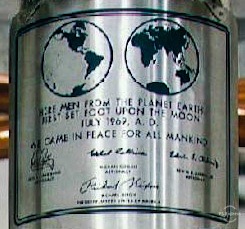
PHOTO CREDIT for plaque first astronauts left on the moon (The plaque says: "Here men from the planet Earth first set foot upon the moon, July 1969 A.D. We came in peace for all mankind."): https://nasa.gov/
Different versions of this reflection have appeared in 2014 and 2017.
For more about docking with the International Space Station, link to:
http://www.howitworksdaily.com/docking-with-the-iss/
"Docking With The ISS"
How It Works Magazine
_________________________
READINGS FOR THE COMING WEEK
Third Sunday in Lent (March 15, 2020)
https://lectionary.library.vanderbilt.edu//texts.php?id=26
Exodus 17:1-7
Psalm 95
Romans 5:1-11
John 4:5-42
_________________________
You are welcome at DaySpring’s Friday morning Lectionary Breakfast. We gather at 8:00 at Our Breakfast Place (the former Egg and I restaurant) for an hour of great fellowship. We eat, we read and discuss scripture, and we laugh; truly an hour like no other.
Join us,
Steve
That’s the premise of Apple TV’s original series, For All Mankind. The show posits that one departure from our actual history, and it occurs in the first few minutes of the very first episode ... it changes everything. What happens, next, is stunning. First, they continue the Apollo rocket program well beyond what we actually did. In time, there are many changes: to the astronaut program, new faces, new leaders, new roles for women and people of color. Even different Presidents occupy the White House than in our reality.
But some things don’t change: like the need for spacecraft to dock with each other out in the void. It is a long, difficult, and highly structured process, even in our real timeline. It actually takes days to accomplish. At the end, it’s a matter of moving mere inches for excruciatingly slow periods of time.
We can observe this, now, when Astronauts attempt to dock with the International Space Station. It’s a long, complicated process, made even longer by the fact that at multiple points fresh permissions must be obtained before proceeding.
I think most of us believe getting to God works much the same way: full speed toward God; stop and wait; get more permissions; slow our approach; stop again; get even more permissions. And then, right when we think we have finally made it, jumped through all the hoops, we're told to wait ... Again.
We see ourselves as the rocket, expending all the energy to connect with God; and we see God as the International Space Station, floating majestically out in space, expending no energy at all, just awaiting our approach. But we have a fundamental misunderstanding about the ISS: we think it can't maneuver. On the contrary, it can maneuver; it just doesn't maneuver any more than is necessary. Any fuel it uses must be replaced (i.e., brought up from the Earth). Plus, at an expense of over $10,000 per pound of propellant, a single 180 degree maneuver costs more than $1,000,000 to execute. At that price, it's no surprise the maneuvering is usually left to the approaching craft.
God has no such limitations.
Nor does God expect us to "do all the work." The scriptures are clear on this, no matter whether you read the Old Testament or the New. James writes, "Draw near to God and God will draw near to you." Don't get the wrong idea, though; it's not a quid pro quo. Look at the father in the parable about the prodigal son: as soon as he sees his son "still a long way from home", he runs to his son, meeting him well down the road (Luke 15).
That is the spirit of the message in this week’s scriptures, especially Psalm 95 and the Gospel of John. God wants us. We are welcome. God is not waiting for us to execute a painstaking series of maneuvers in order to approach him. He is searching for us, looking down the road, ready to run to us at first sighting. God does this for all mankind, for all womankind, for all humankind.
Start your approach ... God will take care of the docking.
_________________________
PHOTO CREDIT for plaque first astronauts left on the moon (The plaque says: "Here men from the planet Earth first set foot upon the moon, July 1969 A.D. We came in peace for all mankind."): https://nasa.gov/
Different versions of this reflection have appeared in 2014 and 2017.
For more about docking with the International Space Station, link to:
http://www.howitworksdaily.com/docking-with-the-iss/
"Docking With The ISS"
How It Works Magazine
_________________________
READINGS FOR THE COMING WEEK
Third Sunday in Lent (March 15, 2020)
https://lectionary.library.vanderbilt.edu//texts.php?id=26
Exodus 17:1-7
Psalm 95
Romans 5:1-11
John 4:5-42
_________________________
You are welcome at DaySpring’s Friday morning Lectionary Breakfast. We gather at 8:00 at Our Breakfast Place (the former Egg and I restaurant) for an hour of great fellowship. We eat, we read and discuss scripture, and we laugh; truly an hour like no other.
Join us,
Steve
Sunday, March 8, 2020
Any Way the Wind Blows (a Steve Orr scripture reflection)
Bohemian Rhapsody was almost killed, multiple times, before the public ever heard it.
Record producers just could not wrap their heads around it. There were sections that seemed to be going somewhere, but never actually arrived. There were sections that seemed to spring up completely out of context to what was happening around them. There were several disparate interjections that didn't seem to relate to anything.
And most unforgivable of all: it was six minutes long!
No one can tell you the meaning of Queen’s Bohemian Rhapsody. Many have tried. But, we’re missing an essential piece: the author’s explanation. As far as we know, Freddie Mercury, who died in 1991, never gave anyone a good explanation of its meaning ... or even if it meant anything at all.
What we do know: it was a piece of rock music intended to evoke a sense of opera. —You try to condense an opera down to six minutes and see what you come up with— Despite going on to be recognized as one of the greatest pieces of rock music ever recorded, people are still confused by it to this day.
Listen to it here, if you want to freshen your memory (or copy and paste this link): https://www.youtube.com/watch?v=jFKBR1ggTMY
It is only through the lens of time that some coherent theme has emerged. When it was released in Iran in 2000, long after Freddie Mercury's death, the band told that audience the song was about a young man who accidentally killed someone, sold his soul to the Devil in a Faustian bargain, cried out to God for help, and was finally redeemed by way of intercession.
So, Bohemian Rhapsody might —might— be a redemption story.
Similar confusion is on display in this week’s gospel scripture, John 3:1-17. Nicodemus, a leader in Israel, sneaks out to meet with Jesus under the cover of darkness. He’s looking for some straight answers. And he gets them ... sort of. They are straight answers. They’re just not answers Nicodemus understands.
He wasn’t alone in his confusion. People were often confused by the words of Jesus, including those closest to Him. Some messages seemed to go in one direction, but never actually ended up where expected. Some of the things He said seemed to spring up completely out of context to what was happening around them. Sometimes, He said things that didn't seem to relate to anything.
... and all, perhaps, for the same reason.
It would be easy to scoff at their confusion, now, two millennia after Jesus walked the Earth. But how might it go if we tried to condense into a few words all the hope of heaven, the long-laid plans for human redemption, and the wisdom of using self-sacrifice to defeat an evil enemy?
Yeah. Unenlightened people would likely be confused by what we said.
And what brings us that enlightenment? Jesus knew Nicodemus wasn’t understanding. So, He told him how he (and we, as well) would come to understand: the Holy Spirit. It, like the wind, had no human restrictions on it, and its beginnings and endings could not be discerned.
We can’t control it, even today, but it is essential to our understanding of Jesus, His message, and His actions. Without the Holy Spirit, the whole thing looks and sounds like foolishness.
Without the Holy Spirit to guide us, our spiritual journey would take us ... any way the wind blows.
_________________________
READINGS FOR THE COMING WEEK
Second Sunday in Lent (March 8, 2020)
https://lectionary.library.vanderbilt.edu//texts.php?id=25
Genesis 12:1-4a
Psalm 121
Romans 4:1-5, 13-17
John 3:1-17 or Matthew 17:1-9
_________________________
Join us Friday morning for DaySpring’s Lectionary Breakfast at Our Breakfast Place (the former Egg and I restaurant. We start at 8:00 and enjoy an hour of scripture, discussion, prayer, and whatever we order off the menu. Clarity is always sought (if not always achieved).
Blessings,
Steve
Record producers just could not wrap their heads around it. There were sections that seemed to be going somewhere, but never actually arrived. There were sections that seemed to spring up completely out of context to what was happening around them. There were several disparate interjections that didn't seem to relate to anything.
And most unforgivable of all: it was six minutes long!
No one can tell you the meaning of Queen’s Bohemian Rhapsody. Many have tried. But, we’re missing an essential piece: the author’s explanation. As far as we know, Freddie Mercury, who died in 1991, never gave anyone a good explanation of its meaning ... or even if it meant anything at all.
What we do know: it was a piece of rock music intended to evoke a sense of opera. —You try to condense an opera down to six minutes and see what you come up with— Despite going on to be recognized as one of the greatest pieces of rock music ever recorded, people are still confused by it to this day.
Listen to it here, if you want to freshen your memory (or copy and paste this link): https://www.youtube.com/watch?v=jFKBR1ggTMY
It is only through the lens of time that some coherent theme has emerged. When it was released in Iran in 2000, long after Freddie Mercury's death, the band told that audience the song was about a young man who accidentally killed someone, sold his soul to the Devil in a Faustian bargain, cried out to God for help, and was finally redeemed by way of intercession.
So, Bohemian Rhapsody might —might— be a redemption story.
Similar confusion is on display in this week’s gospel scripture, John 3:1-17. Nicodemus, a leader in Israel, sneaks out to meet with Jesus under the cover of darkness. He’s looking for some straight answers. And he gets them ... sort of. They are straight answers. They’re just not answers Nicodemus understands.
He wasn’t alone in his confusion. People were often confused by the words of Jesus, including those closest to Him. Some messages seemed to go in one direction, but never actually ended up where expected. Some of the things He said seemed to spring up completely out of context to what was happening around them. Sometimes, He said things that didn't seem to relate to anything.
... and all, perhaps, for the same reason.
It would be easy to scoff at their confusion, now, two millennia after Jesus walked the Earth. But how might it go if we tried to condense into a few words all the hope of heaven, the long-laid plans for human redemption, and the wisdom of using self-sacrifice to defeat an evil enemy?
Yeah. Unenlightened people would likely be confused by what we said.
And what brings us that enlightenment? Jesus knew Nicodemus wasn’t understanding. So, He told him how he (and we, as well) would come to understand: the Holy Spirit. It, like the wind, had no human restrictions on it, and its beginnings and endings could not be discerned.
We can’t control it, even today, but it is essential to our understanding of Jesus, His message, and His actions. Without the Holy Spirit, the whole thing looks and sounds like foolishness.
Without the Holy Spirit to guide us, our spiritual journey would take us ... any way the wind blows.
_________________________
READINGS FOR THE COMING WEEK
Second Sunday in Lent (March 8, 2020)
https://lectionary.library.vanderbilt.edu//texts.php?id=25
Genesis 12:1-4a
Psalm 121
Romans 4:1-5, 13-17
John 3:1-17 or Matthew 17:1-9
_________________________
Join us Friday morning for DaySpring’s Lectionary Breakfast at Our Breakfast Place (the former Egg and I restaurant. We start at 8:00 and enjoy an hour of scripture, discussion, prayer, and whatever we order off the menu. Clarity is always sought (if not always achieved).
Blessings,
Steve
Sunday, March 1, 2020
Stay the Course (a Steve Orr scripture reflection)
Here’s what I remember: some guy fell out of a tree and broke his leg, and one of the main characters was named Finny (maybe).
That's about it.
I'm pretty sure we were supposed to be profoundly affected by it. I’m certain my teacher thought so. But that was not my experience.
I do recall one important thing from reading John Knowles’ novel, A Separate Peace: the title had to do with treaties. It goes something like this: a group of allies agree to go to war together, to all fight the same enemies. That’s the front end.
The back end is this: each country making up the allies also agrees to not make "a separate peace" with the enemy forces. In other words, "we're all in it together, and none of us quits until we all agree to quit."
But, what if we no longer want to fight that war? What if we’ve grown weary of battle? Peace is a nice thing. Would that be so bad? Maybe we wish we could walk away from the battle rather than face the terrible things that are assuredly coming; pain, separation, destruction ... death.
But there is a problem with making a separate peace that may not be readily apparent. If one of the allied countries decided to make a separate peace with the enemy forces, that would be a betrayal of the other countries in the allied forces. The original commitment made by the betraying country would now be without meaning. They would never be trusted by their former allies, ever again.
That is exactly the scenario in this week's Matthew selection. Satan, in the middle of his multi-millennia war against God, has come to Jesus to entice Him into a separate peace.
They both know that some hard times are ahead for Jesus; pain, separation, destruction ... and death. Satan's "temptations" are all inducements for Jesus to abandon his allegiance to God. To step out of the war ... to make a separate peace.
There are times and places for a separate peace. Truly, sometimes it is better to walk away than to continue fighting, even if we can't convince our allies to do so. But for the "war in heaven" that spilled over onto Earth, our oath of fealty must stand firm. Like Jesus, we must resist whatever draws us away from our commitment to God.
Jesus recognized what Satan was up to; knew the power of scripture to counter those enticements. He resisted for our benefit; stayed faithful to His commitment to God; ensured the long-planned strategy would come to fruition.
Do you grow tired of the battle? Do you fear what the future may bring because of your commitment? Turn to prayer and scripture for what you need to carry on.
Stay the course. Now is not the time for any of us to make a separate peace.
___________________________
PHOTO: https://www.amazon.com/Separate-Peace-John-Knowles/dp/0553280414
A different version of this reflection, A Separate Peace, appeared in February 2016.
___________________________
READINGS FOR THE COMING WEEK
First Sunday in Lent (March 1, 2020)
https://lectionary.library.vanderbilt.edu/texts.php?id=24
Genesis 2:15-17; 3:1-7
Psalm 32
Romans 5:12-19
Matthew 4:1-11
Here's a link to a table of all the Bible readings for the season of Lent: https://lectionary.library.vanderbilt.edu//lections.php?year=C&season=Lent
___________________________
We enter the season of Lent preparing for some time of personal reflection. Where do we stand? With God? Are we faithful? Or have we sidelined ourselves from the conflict? Is there something of which we need to repent?
The next six weeks are especially significant in our journey with Jesus through this life. Spend the Friday mornings with us at Lectionary Breakfast. You'll be glad of the fellowship and time in the scriptures. We gather at 8:00 a.m. at Our Breakfast Place (the Waco "Egg and I" restaurant) for an hour like no other.
Blessings,
Steve
That's about it.
I'm pretty sure we were supposed to be profoundly affected by it. I’m certain my teacher thought so. But that was not my experience.
I do recall one important thing from reading John Knowles’ novel, A Separate Peace: the title had to do with treaties. It goes something like this: a group of allies agree to go to war together, to all fight the same enemies. That’s the front end.
The back end is this: each country making up the allies also agrees to not make "a separate peace" with the enemy forces. In other words, "we're all in it together, and none of us quits until we all agree to quit."
But, what if we no longer want to fight that war? What if we’ve grown weary of battle? Peace is a nice thing. Would that be so bad? Maybe we wish we could walk away from the battle rather than face the terrible things that are assuredly coming; pain, separation, destruction ... death.
But there is a problem with making a separate peace that may not be readily apparent. If one of the allied countries decided to make a separate peace with the enemy forces, that would be a betrayal of the other countries in the allied forces. The original commitment made by the betraying country would now be without meaning. They would never be trusted by their former allies, ever again.
That is exactly the scenario in this week's Matthew selection. Satan, in the middle of his multi-millennia war against God, has come to Jesus to entice Him into a separate peace.
They both know that some hard times are ahead for Jesus; pain, separation, destruction ... and death. Satan's "temptations" are all inducements for Jesus to abandon his allegiance to God. To step out of the war ... to make a separate peace.
There are times and places for a separate peace. Truly, sometimes it is better to walk away than to continue fighting, even if we can't convince our allies to do so. But for the "war in heaven" that spilled over onto Earth, our oath of fealty must stand firm. Like Jesus, we must resist whatever draws us away from our commitment to God.
Jesus recognized what Satan was up to; knew the power of scripture to counter those enticements. He resisted for our benefit; stayed faithful to His commitment to God; ensured the long-planned strategy would come to fruition.
Do you grow tired of the battle? Do you fear what the future may bring because of your commitment? Turn to prayer and scripture for what you need to carry on.
Stay the course. Now is not the time for any of us to make a separate peace.
___________________________
PHOTO: https://www.amazon.com/Separate-Peace-John-Knowles/dp/0553280414
A different version of this reflection, A Separate Peace, appeared in February 2016.
___________________________
READINGS FOR THE COMING WEEK
First Sunday in Lent (March 1, 2020)
https://lectionary.library.vanderbilt.edu/texts.php?id=24
Genesis 2:15-17; 3:1-7
Psalm 32
Romans 5:12-19
Matthew 4:1-11
Here's a link to a table of all the Bible readings for the season of Lent: https://lectionary.library.vanderbilt.edu//lections.php?year=C&season=Lent
___________________________
We enter the season of Lent preparing for some time of personal reflection. Where do we stand? With God? Are we faithful? Or have we sidelined ourselves from the conflict? Is there something of which we need to repent?
The next six weeks are especially significant in our journey with Jesus through this life. Spend the Friday mornings with us at Lectionary Breakfast. You'll be glad of the fellowship and time in the scriptures. We gather at 8:00 a.m. at Our Breakfast Place (the Waco "Egg and I" restaurant) for an hour like no other.
Blessings,
Steve
Saturday, February 22, 2020
From Good to Great to Gone (a Steve Orr scripture reflection)
“My name is Ozymandias, king of kings:
Look on my works, ye Mighty, and despair!”
Nothing beside remains.
Round the decay of that colossal wreck, boundless and bare,
The lone and level sands stretch far away.”
—Percy Bysshe Shelley (a selection from his poem, Ozymandias)
We all know this ... but it helps to be reminded from time to time: nothing in this life lasts forever. Even the mighty fall. Whether it’s a corporation, a political leader, or a superstar, there comes a day when they are no longer on the top of the heap.
Jim Collins and partners started tracking the life cycles of corporations with their groundbreaking bestseller, "Built to Last." There they investigated why some companies (e.g. Disney or Procter & Gamble) continued at the top of their respective fields decade after decade, while comparable others came and went. They followed this with a second bestseller, "Good to Great." That sought to know why some companies (e.g. Gillette or Walgreens) made that leap from OK to greatness while others did not. Finally, it seemed only appropriate they should turn their searchlight on "How the Mighty Fall."
Apparently, like mountain climbing, there are only a few ways to the top, but you can fall all sorts of ways. Their central discovery? A "company can indeed look like the picture of health on the outside yet already be in decline, dangerously on the cusp of a huge fall..."
In other words, the seeds of our destruction are usually sown long before the harvest. If only there were some way to see that fall coming ...
Collins and crew found there are some usual stages through which the mighty descend on their way to the bottom; stages that, if brought to their attention, might allow them to reverse course before they are too far gone. The first three are particularly instructive:
Stage 1: Hubris Born of Success
Stage 2: Undisciplined Pursuit of More
Stage 3: Denial of Risk and Peril
These three and others are all present in the nations that surrounded Israel in the Old Testament years, constantly conspiring to bring about its downfall. But, God sent them warnings. Through the Psalmist and others, God showed them their hubris, their unbridled appetite, and the risks they were incurring by conspiring against His will.
This week's scriptures, especially Psalm 2, tell of God's sovereignty and the authority He has conferred on His Anointed One (Jesus). God makes it clear, to the nations and to us: He is the authority and that He has anointed His chosen.
Kings, rulers, judges, and everyone else must recognize both His sovereignty and His anointed. Collins and crew also discovered how corporations can avoid an early decline. There are ways to bring wisdom into the equation. Likewise, everyone, both mighty and otherwise, must be wise in recognizing God’s sovereignty over our lives.
The alternative is to discover, most personally, how the mighty fall.
_________________________
Click for PHOTO (plus all the words to Ozymandias and a funny take by humorist Ogden Nash). Or, Copy and Paste: https://muddlet.wordpress.com/2018/01/07/ozymandias-ogdeniasis/
A different version of this reflection, How the Mighty Fall, appeared in 2014.
_________________________
READINGS FOR THE COMING WEEK
Transfiguration Sunday (February 23, 2020)
https://lectionary.library.vanderbilt.edu//texts.php?id=22
Exodus 24:12-18
Psalm 2 or Psalm 99
2 Peter 1:16-21
Matthew 17:1-9
_________________________
Join us Friday morning, if you can. As usual, we will meet at Our Breakfast Place (the Waco "Egg and I") at 8:00 to chew on and digest some scripture while chowing down on some great food.
Enjoy the week!
Steve
Look on my works, ye Mighty, and despair!”
Nothing beside remains.
Round the decay of that colossal wreck, boundless and bare,
The lone and level sands stretch far away.”
—Percy Bysshe Shelley (a selection from his poem, Ozymandias)
We all know this ... but it helps to be reminded from time to time: nothing in this life lasts forever. Even the mighty fall. Whether it’s a corporation, a political leader, or a superstar, there comes a day when they are no longer on the top of the heap.
Jim Collins and partners started tracking the life cycles of corporations with their groundbreaking bestseller, "Built to Last." There they investigated why some companies (e.g. Disney or Procter & Gamble) continued at the top of their respective fields decade after decade, while comparable others came and went. They followed this with a second bestseller, "Good to Great." That sought to know why some companies (e.g. Gillette or Walgreens) made that leap from OK to greatness while others did not. Finally, it seemed only appropriate they should turn their searchlight on "How the Mighty Fall."
Apparently, like mountain climbing, there are only a few ways to the top, but you can fall all sorts of ways. Their central discovery? A "company can indeed look like the picture of health on the outside yet already be in decline, dangerously on the cusp of a huge fall..."
In other words, the seeds of our destruction are usually sown long before the harvest. If only there were some way to see that fall coming ...
Collins and crew found there are some usual stages through which the mighty descend on their way to the bottom; stages that, if brought to their attention, might allow them to reverse course before they are too far gone. The first three are particularly instructive:
Stage 1: Hubris Born of Success
Stage 2: Undisciplined Pursuit of More
Stage 3: Denial of Risk and Peril
These three and others are all present in the nations that surrounded Israel in the Old Testament years, constantly conspiring to bring about its downfall. But, God sent them warnings. Through the Psalmist and others, God showed them their hubris, their unbridled appetite, and the risks they were incurring by conspiring against His will.
This week's scriptures, especially Psalm 2, tell of God's sovereignty and the authority He has conferred on His Anointed One (Jesus). God makes it clear, to the nations and to us: He is the authority and that He has anointed His chosen.
Kings, rulers, judges, and everyone else must recognize both His sovereignty and His anointed. Collins and crew also discovered how corporations can avoid an early decline. There are ways to bring wisdom into the equation. Likewise, everyone, both mighty and otherwise, must be wise in recognizing God’s sovereignty over our lives.
The alternative is to discover, most personally, how the mighty fall.
_________________________
Click for PHOTO (plus all the words to Ozymandias and a funny take by humorist Ogden Nash). Or, Copy and Paste: https://muddlet.wordpress.com/2018/01/07/ozymandias-ogdeniasis/
A different version of this reflection, How the Mighty Fall, appeared in 2014.
_________________________
READINGS FOR THE COMING WEEK
Transfiguration Sunday (February 23, 2020)
https://lectionary.library.vanderbilt.edu//texts.php?id=22
Exodus 24:12-18
Psalm 2 or Psalm 99
2 Peter 1:16-21
Matthew 17:1-9
_________________________
Join us Friday morning, if you can. As usual, we will meet at Our Breakfast Place (the Waco "Egg and I") at 8:00 to chew on and digest some scripture while chowing down on some great food.
Enjoy the week!
Steve
Sunday, February 16, 2020
Another Rocket, Man (a Steve Orr scripture reflection)
He knew what he wanted to be ... and it wasn’t this.
At the beginning of Robert Heinlein’s science fiction novel, Starman Jones, young Max lived on a small farm in the Ozarks with his stepmother. Once a week, after finishing his chores, he made his way down the hill a bit where he lay back and waited. Soon, he heard the roar and saw the bright flame that lifted the weekly Moon Shuttle off the Earth and on its way to space. The light of that rocket flame was a beacon to Max Jones; the roar, a siren’s song. They called to something deep within him, a great desire unfulfilled by his daily life.
But wanting something is not the same as achieving it.
Legend has it that NASA scientists considered two different methods of moving a rocket from the Earth to outer space:
Method 1 - "constant acceleration" meant a slow launch, increasing the speed a little more each second until breakthrough velocity was achieved. It would be easy on the Astronauts, but lacked the certainty of the other method. Plus, and this is key, constant acceleration was much slower to achieve Earth orbit.
Method 2 - “quick thrust" or “intense acceleration” meant a faster launch. This would be harder on the Astronauts. They would be subjected to several gravities of force "pressing" on them. This high “g-force” could, if endured too long, injure or kill them.
NASA chose Method 2. That excessive G-force the Astronauts would have to endure during takeoff was one of the reasons our astronauts needed to possess the "right stuff," a collection of physical and mental attributes essential to their success. This exclusivity was necessary. Almost anyone could handle the takeoff using the gentler "constant acceleration" method. Only a few could handle the intensity of the other.
And that brings us to this week’s 1st Corinthians passage. The more influential Corinthians who were part of that church had the idea that their way was the only way to be a follower of Jesus; that only those with the "right stuff" (like them) could do it. Paul's letter to the church confronts them with the truth: they’re not the spiritually gifted Pneumatikoi ("Spirit People") they imagined themselves to be, far from it.
They were so far from maturity, they were more like babies, only able to stomach the "milk" of Paul’s teachings. Their superiority complex and exclusivity were tearing apart the church at Corinth. Paul needed to remind them: God is the one who "gives the growth."
Spiritual maturity comes about when we submit to the shaping of our creator; not just because we say it’s so. Max Jones didn’t become Starman Jones just by desiring it. The transformation from farmer to Starman took time. He went through a process, experienced several life challenges. These, eventually, shaped him for the job.
We must have faith that God has invested each of us with sufficient "right stuff" for our respective spiritual journeys. God will honor our constancy with a spiritual growth pace and trajectory that is right.
God knows which launch method is best for each of us.
_______________________
PHOTO: https://www.amazon.com/Starman-Jones/dp/B001EPO4XO
A different version of this reflection appeared in 2014 as Constant Acceleration.
_______________________
READINGS FOR THE COMING WEEK
Sixth Sunday after the Epiphany (February 16, 2020)
https://lectionary.library.vanderbilt.edu//texts.php?id=18
Deuteronomy 30:15-20
Psalm 119:1-8
1 Corinthians 3:1-9
Matthew 5:21-37
Join us Friday morning for DaySpring’s Lectionary Breakfast. We continue to meet at 8:00 at Our Breakfast Place (same location as the Waco Egg and I restaurant). The scriptures and the fellowship are great. We eat the same kinds of stuff as the astronauts ... just not as paste in tubes.
No excessive G-force will be applied.
Enjoy the week!
Steve
At the beginning of Robert Heinlein’s science fiction novel, Starman Jones, young Max lived on a small farm in the Ozarks with his stepmother. Once a week, after finishing his chores, he made his way down the hill a bit where he lay back and waited. Soon, he heard the roar and saw the bright flame that lifted the weekly Moon Shuttle off the Earth and on its way to space. The light of that rocket flame was a beacon to Max Jones; the roar, a siren’s song. They called to something deep within him, a great desire unfulfilled by his daily life.
But wanting something is not the same as achieving it.
Legend has it that NASA scientists considered two different methods of moving a rocket from the Earth to outer space:
Method 1 - "constant acceleration" meant a slow launch, increasing the speed a little more each second until breakthrough velocity was achieved. It would be easy on the Astronauts, but lacked the certainty of the other method. Plus, and this is key, constant acceleration was much slower to achieve Earth orbit.
Method 2 - “quick thrust" or “intense acceleration” meant a faster launch. This would be harder on the Astronauts. They would be subjected to several gravities of force "pressing" on them. This high “g-force” could, if endured too long, injure or kill them.
NASA chose Method 2. That excessive G-force the Astronauts would have to endure during takeoff was one of the reasons our astronauts needed to possess the "right stuff," a collection of physical and mental attributes essential to their success. This exclusivity was necessary. Almost anyone could handle the takeoff using the gentler "constant acceleration" method. Only a few could handle the intensity of the other.
And that brings us to this week’s 1st Corinthians passage. The more influential Corinthians who were part of that church had the idea that their way was the only way to be a follower of Jesus; that only those with the "right stuff" (like them) could do it. Paul's letter to the church confronts them with the truth: they’re not the spiritually gifted Pneumatikoi ("Spirit People") they imagined themselves to be, far from it.
They were so far from maturity, they were more like babies, only able to stomach the "milk" of Paul’s teachings. Their superiority complex and exclusivity were tearing apart the church at Corinth. Paul needed to remind them: God is the one who "gives the growth."
Spiritual maturity comes about when we submit to the shaping of our creator; not just because we say it’s so. Max Jones didn’t become Starman Jones just by desiring it. The transformation from farmer to Starman took time. He went through a process, experienced several life challenges. These, eventually, shaped him for the job.
We must have faith that God has invested each of us with sufficient "right stuff" for our respective spiritual journeys. God will honor our constancy with a spiritual growth pace and trajectory that is right.
God knows which launch method is best for each of us.
_______________________
PHOTO: https://www.amazon.com/Starman-Jones/dp/B001EPO4XO
A different version of this reflection appeared in 2014 as Constant Acceleration.
_______________________
READINGS FOR THE COMING WEEK
Sixth Sunday after the Epiphany (February 16, 2020)
https://lectionary.library.vanderbilt.edu//texts.php?id=18
Deuteronomy 30:15-20
Psalm 119:1-8
1 Corinthians 3:1-9
Matthew 5:21-37
Join us Friday morning for DaySpring’s Lectionary Breakfast. We continue to meet at 8:00 at Our Breakfast Place (same location as the Waco Egg and I restaurant). The scriptures and the fellowship are great. We eat the same kinds of stuff as the astronauts ... just not as paste in tubes.
No excessive G-force will be applied.
Enjoy the week!
Steve
Subscribe to:
Posts (Atom)


