Monday, April 15, 2013

Come, And Eat Breakfast (a Lectionary reflection by Steve Orr)


My weekday mornings as a child, thousands and thousands of them, started pretty much the same way every time. I awoke to the fragrance and pooka-pooka sounds of coffee being transformed in the percolator. Joining that were the sounds and smells of country bacon snapping and crackling in our cast iron skillet. Of course, well before I was awake, Dad had started all of this by lighting the burners on our gas stove. But I slept through that initial whoosh of energy. Later there would be eggs, fried over medium and, on the best days, bread toasted in the oven under the broiler, dark and crispy around the edges with four yellow bulges where the little chunks of broken butter pats had been dotted.

As anyone can tell you, I am not a morning person. I have to gradually transition from sleep, in stages; gently trading pieces of sleepiness for pieces of wakefulness. I am like a deep sea diver, slowly ascending from the depths. I will eventually come to the surface, but, oh, am I slow to take hold of the day.

So, these fragrances and gentle noises, and thoughts of eggs and toast to come, were an essential lever to get me from horizontal to vertical, especially on school days. And, because our family always talked at our meals, by the time I needed to head out the door to tackle my day, I was fully awake, ready in every way that a human being could be.

I think my memories of these morning routines are a large part of the reason why this week's John 21 passage is one of my favorites. I love the ordinariness of this episode. One night Peter says, "I'm going fishing." The rest of the guys, at loose ends, a bit shell shocked, exhausted from the "not knowing" of whatever is coming next, say, "Good idea. We'll come with you." That night's fishing, also quite ordinarily, doesn't produce a single fish. But that's not really the point of fishing, is it?

When Jesus arrives early the next morning, though, he changes everything; helps them catch a great deal of fish, and then says, "Come, and eat breakfast."

It reminds me of when God fed Elijah in 1st Kings 19, strengthening him for the 40 days journey that was still ahead of him, and, really, because of what occurred at the end of those 40 days, for all of his future actions as a prophet of God in this world.

Reeling from recent events, restless, frustrated and stressed, the Apostles needed . . . something. Jesus cooked breakfast for his people. He called them to breakfast and they came, and they ate.

God doesn't ask of us what we cannot do. It's just that we often fail to perceive what we are really capable of. And, if we will but take it, he provisions us so we can carry out what he has planned.

Come, and eat breakfast.

###############################
http://lectionary.library.vanderbilt.edu
READINGS FOR THE COMING WEEK
Third Sunday of Easter (April 14, 2013)

Acts 9:1-6, (7-20)
Psalm 30
Revelation 5:11-14
John 21:1-19

Are you going to be in Waco on a Friday? We gather at 8:00 each Friday morning for food and fellowship at The Egg and I (on Franklin, behind the Outback). We have a good breakfast; eggs, bacon, pancakes, coffee . . .

And toast. Really good toast :-)

Enjoy the week!
Steve

Saturday, March 30, 2013

One Brief Shining Moment


(a Lectionary reflection by Steve Orr)

We disagree, we Jesus folk.

Contrary to what those looking in at us may think, there is no all encompassing cohesion on the inside of our belief set. We disagree about many things. We even disagree about what we call ourselves: Catholic, Anglican, Presbyterian, Methodist, Baptist, etc. . . . Or maybe just "Christian" . . . And for those with concerns about even that term, perhaps something simpler still: "follower of Jesus" or just "believer."

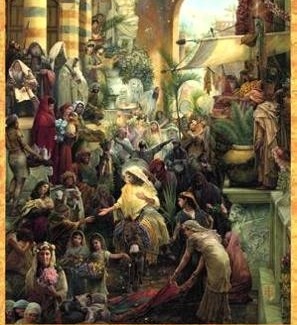
We disagree like this because we're human ---It may be our hallmark among the species :-)--- Still, there are a few things we agree on. One of them is this: one day Jesus came riding into Jerusalem on the back of a donkey. And then, for a bright shining moment, the crowd saw him as he truly was, their King.

It's difficult for us to grasp this scenario. The components seem, as one of my ancestors was fond of saying, "all whomper jawed." It stretches our credulity to think people would react with alleluias, blessings, and shouts of joy . . .

. . . to a man riding on a donkey.

So how do I explain it? My kingdom for a metaphor.

Most of us moderns have trouble relating to the extremely high level of anticipation flooding through the people of Israel at that time. I think that's why we kind of "skip over" this part when we think of what has come to be known as Passion Week. We know that the very heart of our beliefs are tied to the later events of that week. And, of course, we know that this so called "triumphal entry" was soon followed by some very UN-triumphal events, including His death. So, we "note" this procession, thinking of it as a kind of parade, and then shift our focus to what comes next.

But I am asking you to go back, to roll back the film if you will, to witness again this almost magical procession into Jerusalem. It's important, maybe more important than you've ever considered.

Imagine a man living near that city gate. He started his day having to shoulder his way through the crowds---the city is swelled with visitors readying themselves for the Passover later that week---so he could select the lamb for his family's Passover meal. Now, enjoying the relatively spacious elbow room of his rooftop, he is, perhaps, cooking that lamb. A part of his mind is certainly on the story of the first Passover and how, because of the blood of those first Passover lambs, the Angel of Death passed over the homes of his ancestors.

Another part is likely considering what everyone has been talking about: this man, Jesus, who supposedly walks on water, heals the sick, and raises the dead! Everyone had been speculating that maybe, just maybe, at long last their deliverance has come; that this is the Messiah, the Anointed One, the King who will throw off the shackle of Rome.

Then, he hears a commotion, over near the gate. He raises his eyes to take in something that, at first, he can hardly credit. He sees a man, riding into Jerusalem on a donkey; sees a growing crowd pulling off their cloaks and laying them, along with young palm fronds, into the path before the donkey.

And he feels a frisson of energy charge up his spine.

Everything is there just as predicted by the prophets: the donkey, the crowds, the shouts of "Hosanna!" and "Blessed is the King who comes in the name of The Lord!" Suddenly he finds himself running; down the steps, out the door, toward the gate; hears his own voice joining those of strangers and neighbors in joyful expression of what has been pent up for SO LONG.

He is shouting and laughing and crying, living to the fullest the greatest moment of his life. All is well! All will be well! At last, at last. Their savior has come.

People with a great desire to believe in their hope are charged with an energy that is truly mind-blowing in its intensity.

The thrill of hope.

That's what we are missing if we slide over this scene. That's what we MUST go back for. If we truly ARE believers, then this is how we must see our Lord, triumphantly arriving as our King.

###############################
http://lectionary.library.vanderbilt.edu

READINGS FOR EASTER
Acts 10:34-43
Isaiah 65:17-25
Psalm 118:1-2, 14-24
1 Corinthians 15:19-26
Acts 10:34-43
John 20:1-18
Luke 24:1-12

I know this reflection doesn't "line up" with the readings for Easter Sunday. I did this on purpose. Unless we realize just who it is we believe in, our understanding of what follows the triumphal entry is missing its best context. We must always remember with what "longing fulfilled," with what HOPE, He was welcomed into Jerusalem.

If we can even come close to that in our own joy, we will begin to understand the truth of our current relationship with God.

If you're in Waco, join us Friday at The Egg and I for some good food and something even better. We will be there at 8:00 a.m. for about an hour of thought-provoking, idea storming, thrill-inducing moments.

And absolutely full of hope.

Enjoy the week!
Steve

Monday, March 11, 2013

Tom Swift and the Amazing BRIC!

I'm pretty sure that, for me, it all started with "Tom Swift and His Flying Lab." I mean, I knew about Sputnik--had even lain out at night in our backyard to watch it pass by overhead--and I had certainly read my share of space operas, but I was no Rocket Boy. Up until then, it had always been more about the adventure and less (near zero) about the technology used to make the adventure possible.

I had read some Tom Swift adventures, but they were the older novels, books like "Tom Swift and His Motorcycle" (1910). Before me on the shelf that day (circa 1960) was the first adventure of Tom Swift, JUNIOR. Standing there in the store, I goggled at the cover art for TSaHFL. That giant, jet-powered VTOL airplane--even bigger than the Spruce Goose!--with normal-sized jet planes flying out of its onboard hangar, the Earth hanging below it and the blackness of space above it; that's the moment I was hooked.

I wanted to be an Astronaut.

I begged my parents for the money to buy that book (There were no NEW books of this type in any lending library to which I had access. See earlier reference to TS and his motorcycle.). Suffice to say, some time passed before I was able to read it all the way through. Eventually, though, I did read it, and reread it, and again a few MORE times until I could just see myself working in that lab, circling the globe at near orbital heights, studying everything below . . . and above.

So. It has now been more than half a century since that pivotal moment. And, no, I am not (nor do I expect to be) an Astronaut. Nor am I a credentialed scientist. But my inner Rocket Boy still lives. And he was delighted to tour the Baylor Research and Innovation Collaborative (BRIC), recently . . . especially when our tour brought us to the Space Sciences Lab (Mission Design & Data), Satellite Integration, and the Dusty Plasma Simulator. I was in heaven :-)

The BRIC, housing all sorts of scientific projects and activities, is partly research lab central and partly business incubator. If you ever have the opportunity to tour, I highly recommend it. For the kind of fascination where hours feel like minutes, it ranks up there with The Armstrong Browning Library & Museum.

One of the more interesting aspects of the BRIC (among hundreds) is the story of the facility, itself. In addition to what goes on inside it, this massive, 300,000 square foot building is also architecturally fascinating. What now houses cutting edge science was once . . . a tire factory.

General Tire opened the plant in Waco, Texas in the early 1940's. And it was a thriving operation. Until it closed its doors for good. Sure, the "bones" were still there; they were always substantial. But what do you do with a tire factory when there is no longer a need for one? So, for decades, it sat; empty, abandoned, useless, worthless. Circumstances had brought it low. For the longest time, it was lost.

And no amount of wishing was going to change that. And it would still be just like that if some folks had not decided to redeem it, reshape it, re-task it. What was old has passed away; it's now a new creation.

All of this week's Lectionary selections are about redemption. Read them and experience a quiet joy spreading across your thoughts and emotions. These Bible passages are about being brought back from the brink, having new life breathed in, being rescued from evil, coming home.

###############################
http://lectionary.library.vanderbilt.edu

READINGS FOR THE WEEK
Fourth Sunday in Lent (March 10, 2013)

Joshua 5:9-12
Psalm 32
2 Corinthians 5:16-21
Luke 15:1-3, 11b-32

If you're in Waco on Friday morning, join us at 8:00 for breakfast and the pleasure of talking about how the words of the Bible actually work in our real lives. We'll be at The Egg and I (on Franklin behind The Outback).

Enjoy the week!
Steve

Sunday, March 3, 2013

The Lone Ranger (a Lectionary reflection by Steve Orr)


One of my favorite television shows as a child was "The Lone Ranger." Each week I made certain I could be in front of the TV at just the right time to catch the most recent adventure of that masked champion. This could be a challenging enterprise, on occasion. We had only one black & white television, located in our small living room, and there were four us competing for its use; plus there were the usual noises and interruptions of house-cleaning, meal prep, and the general activities of life to serve as distractions. And it was a very small house.

Still, each week I found a way to watch and listen as he and his trusty sidekick, Tonto, thwarted the nefarious plans of bad guys all across the west; saving towns from ruffians, banks from robbers, and widows from those who attempted to swindle them out of their hard-scrabble farms.

One of my favorite parts of each show was at the very end, after he and Tonto had ridden away. Invariably, one of the townspeople, or maybe a ranch hand, or, even more poignantly, a child of that week's widow, would raise the question: "Who WAS that masked man?"

I loved that moment.

Because I knew.

I knew what the answer was going to be. I was on the inside. I had special knowledge these folks were lacking. And even though the answer was the same every time, I loved hearing it: "Why, THAT was the Lone Ranger!"

Which brings me to the reading from Luke in this week's Lectionary selections. On the first reading, it may seem a little odd; talk of people having died in horrible ways, followed by a parable about a fig tree. And it's owner. And the gardener.

Still, if you read through it a few times, I think you will understand this: Jesus is telling the crowd "Don't be distracted by the news. What is important is NOT what Herod is doing and it is NOT whatever horrible thing has happened to other people. Stay focused on what IS important: repentance.

And then He underscores this message with the parable about the unfruitful fruit tree. The message? Produce what you are supposed to produce (for example: Love God and love your neighbor as yourself) or face the possibility of being removed from to grove. Permanently.

For me, I especially like the Gardner stepping in to intercede on behalf of the fruit tree; asking for one last chance. I picture some of those disciples sitting around, possibly over the evening meal, discussing events of the day and especially the words of Jesus, and quite possibly agreeing it was a wonderful thing for the Gardner to step in and advocate on behalf of saving that tree; staving off, even if only for a while, the consequence of not bearing its fruit. But then one of them suddenly says, "I'm pretty sure I know who the "owner" is in that parable, and I think WE are the fruit trees, but who is the gardener?!"

It seems so clear from our perspective of two millennia later. But they seemed to have had a recurring problem with understanding who Jesus really was. It is likely that most people could not "connect the dots" until after the resurrection. Scripture supports that conclusion.

The take away here, for us, is that we have an advocate, one who asks God to give us just one more chance so we can be spared. And, unlike many who actually heard the words of Jesus as He spoke them, we know the answer to the question:

"Who was that masked man?"

###############################
http://lectionary.library.vanderbilt.edu

READINGS FOR THE COMING WEEK
Third Sunday in Lent (March 3, 2013)
First reading: Isaiah 55:1-9
Psalm: Psalm 63:1-8
Second reading: 1 Corinthians 10:1-13
Gospel: Luke 13:1-9

It would be so great if you could join us for breakfast at "The Egg and I." If you are in Waco on Friday morning, you will find us there at 8:00, chowing down of some good victuals and kicking around this week's scripture selections.

No one will be required to whistle or hum the relevant part of the "William Tell Overture" . . . however, those that do will receive free admission ;-)

Enjoy the week!
Steve

Sunday, February 24, 2013

The Friendly Home (a Lectionary reflection by Steve Orr)


I had my first lesson on orphans in the Third Grade; when I struck up a conversation with Bill. We stood around on the playground of Andrew Jackson Elementary, sensing that recess was coming to a close. We knew we would soon be told to line up, so most of us gathered near the big wood and glass doors that led back into the building.

Bill had carroty red hair, cut in a burr, and more freckles on his face than I had ever seen in my brief life. He was shorter than most of the people in our class, girls included, and that was made obvious by the expanse of blue jean double-rolled into a huge cuff where his stubby legs met his feet.

I don't recall what conversational path brought me to the question that day, but I clearly remember what happened when I asked Bill, "And where is YOUR house?"

Everyone stopped talking.

And Bill looked stricken.

Is it just me or did anyone else feel that you were woefully uninformed as you made your way through school? I often had this feeling that OTHER children's parents must tell them things. It seemed I was always the one to ask the awkward question or speak the unspeakable. I sometimes felt as if I had been dressed in oversized rubber boots and sent to walk through delicate flowers.

So, while Bill walk away, Becky turned to me and, with as much exasperation as a Third Grade girl can muster, whisper-hissed, "He lives at The Friendly Home."

"The Friendly Home" meant nothing to me, but I had the sense to wait until I got home to ask about it. It was at supper that I learned we had an orphanage there in my hometown of Paducah, Kentucky, and that some of the children who lived there attended our school.

Based on my reading of "Little Orphan Annie" stories, I thought orphans were children who did not have parents. It was some years before I learned the term could have a much broader meaning than I had gleaned from reading the Sunday funnies. Quite by accident I later learned that children living at The Friendly Home might, in fact, actually HAVE one or more parents. This was much more difficult for my parents to explain to me.

In time, of course, I did come to understand that circumstances arise from which the best solution is to separate parents and their children, as horrible as that sounds. But the circumstance that struck me as the saddest was when parents voluntarily abandoned their children. I just could not grasp how someone could "give up" their child. Still later in life, I came to understand that sometimes parents "give up" their children without ever physically separating for them; that "abandonment" can happen when parents stop caring about their children even though they continue to live in the same home.

With all of this as background, I was a bit shocked to read in one of this week's Lectionary passages that, "Even if my father and mother abandon me, the Lord will hold me close." (Psalms 27:10 NLT).

But, that's great news, right? It is wonderfully comforting to know that God wants us even when others don't. So, where is the shock?

It is in the phrase at the very beginning of the Psalm: "Of David."

David? Shepherd David? Songwriter David? Giant-killer David? KING David?! Why would David write about being abandoned by his parents? There is nothing in scripture to suggest David was an orphan or that he ever lived in an orphanage. Quite the opposite; father, mother, and several siblings. So where does he get the basis for verse 10?

I think I know. David was the least in his family, in more ways than one; he was the youngest, and, based on his father's response when the prophet Samuel asked Jesse to present his sons, the last thing on his father's mind. His brothers also treated David as someone of little value in the "real" world. Yes, I think that, even though he lived at home in his youth, David understood abandonment.

You can be an orphan without living at The Friendly Home.

###############################
http://lectionary.library.vanderbilt.edu

READINGS FOR THE COMING WEEK
Second Sunday in Lent (February 24, 2013)
Genesis 15:1-12, 17-18
Psalm 27
Philippians 3:17-4:1
Luke 13:31-35 or Luke 9:28-36, (37-43a)

We're just starting into the season of Lent. Join us one of these Friday mornings (8:00 a.m.) at "The Egg and I" in Waco for some delicious breakfast and some equally tasty conversation about the scriptures.

Enjoy the week!
Steve

Wednesday, February 13, 2013

A [well, sort of] LECTIO DIVINA FOR LENT

Not looking forward to fasting? Isaiah has some alternatives for you.

"HERE is the way I want you to fast.

Set free those who are held by chains without any reason. Untie the ropes that hold people as slaves. Set free those who are crushed. Break every evil chain.

Share your food with hungry people. Provide homeless people with a place to stay. Give naked people clothes to wear. Provide for the needs of your own family.

THEN the light of my blessing will shine on you like the rising sun. I will heal you quickly. I will march out ahead of you. And my glory will follow behind you and guard you. That is because I always do what is right. You will call out to me for help. And I will answer you. You will cry out. And I will say, 'Here I am.'

Get rid of the chains you use to hold others down. Stop pointing your finger at others as if they had done something wrong. Stop saying harmful things about them.

Work hard to feed hungry people. Satisfy the needs of those who are crushed. THEN my blessing will light up your darkness. And the night of your suffering will become as bright as the noonday sun." (Isaiah 58:6-10 NIRV - New International Readers Version)


"THIS is the kind of fast day I'm after: to break the chains of injustice, get rid of exploitation in the workplace, free the oppressed, cancel debts. What I'm interested in seeing you do is: sharing your food with the hungry, inviting the homeless poor into your homes, putting clothes on the shivering ill-clad, being available to your own families. Do this and the lights will turn on, and your lives will turn around at once. Your righteousness will pave your way. The God of glory will secure your passage. THEN when you pray, God will answer. You'll call out for help and I'll say, 'Here I am.' If you get rid of unfair practices, quit blaming victims, quit gossiping about other people's sins, If you are generous with the hungry and start giving yourselves to the down-and-out, your lives will begin to glow in the darkness, your shadowed lives will be bathed in sunlight.
(Isaiah 58:6-10 MSG - The Message)


“I will tell you THE KIND OF FAST I WANT:
>Free the people you have put in prison unfairly and undo their chains. Free those to whom you are unfair and stop their hard labor.
>Share your food with the hungry and bring poor, homeless people into your own homes. When you see someone who has no clothes, give him yours, and don’t refuse to help your own relatives.
>THEN your light will shine like the dawn, and your wounds will quickly heal. Your God will walk before you, and the glory of the Lord will protect you from behind. THEN you will call out, and the Lord will answer. You will cry out, and he will say, ‘Here I am.’
>If you stop making trouble for others, if you stop using cruel words and pointing your finger at others, if you feed those who are hungry and take care of the needs of those who are troubled, THEN your light will shine in the darkness, and you will be bright like sunshine at noon." (Isaiah 58:6-10 NCV - New Century Version)

[ABOUT LECTIO DIVINA: It is a practice some do to help them absorb the full meaning of scripture for their real lives. There are various approaches. It is common to read a scripture three times, pausing between each reading to meditate on the meaning, wisdom, and application . . . or, at least that's how I do it :-) --Steve ]

Sunday, February 3, 2013

Shade Number 14 Welder's Glass

(a brief Lectionary reflection by Steve Orr)

Looking directly into the sun, even for a few seconds, will destroy your retina. You would not immediately notice that damage. Your retina has no pain receptors. But the damage occurs. And it is permanent.

Sadly, many people discover this truth after trying to watch a solar eclipse through inadequate filters; sun glasses, photographic film, smoked glass, etc. In fact, the safest way to watch a solar eclipse is through reflection; not look directly at it, at all. The irony here is that it is perfectly safe to view a TOTAL ECLIPSE with the naked eye. It is the minutes before totality and those immediately after that hold the greatest threat to vision. In those minutes, many of us feel safe to look directly at the sun presuming enough of the harmful rays are blocked because the moon "covers" much of the sun.

One filter that DOES provide adequate protection for direct viewing of the eclipse before and after totality is "shade number 14 welder's glass." Have you ever looked at the glass in a Welder's helmet? At SN 14, the glass only transmits about 3 millionths of the visible light striking its surface. It is designed to protect the eyes of the wearer by keeping out all but the very brightest of lights, and it only allows a small amount of that through.

So, what do you see when you look at a Welder's helmet fitted with SN 14 glass? You see yourself. Yes, under certain circumstances you can see THROUGH it, but mostly you just see a very dark reflection of yourself and whatever is around you.

It makes me think of 1st Corinthians 13:12. I have always liked the rendering in the King James Version "For now we see through a glass, darkly; but then face to face: now I know in part; but then shall I know even as also I am known." (1 Corinthians 13:12 KJV)

Still, whether it is THROUGH a dark glass or into a dim mirror that we see, the effect is the same: an imperfect vision of reality.

The point of the 13th chapter of 1st Corinthians is this: we are to love, and we are not to allow ourselves to be distracted from that charge by ANYTHING. We all are curious to one degree or other about the great mysteries. What does the future hold? What follows death? Is there another age to come, and if so, what will it be like (and will I be there)? But we are not to know those answers just yet. And until that time, we are to be very actively engaged in faith, hope, and love.

As for me, I am happy to "see through a glass, darkly" as I sojourn here. Because, what's on the other side of that glass is very, very, very bright.


###############################
http://lectionary.library.vanderbilt.edu
READINGS FOR THE COMING WEEK
Fourth Sunday after the Epiphany (February 3, 2013)

Jeremiah 1:4-10
Psalm 71:1-6
1st Corinthians 13:1-13
Luke 4:21-30