Showing posts with label hope. Show all posts

Sunday, May 22, 2016

Winter Is Coming (a Lectionary reflection by Steve Orr)

I am not a winter person.

It's not much of a confession to anyone who knows me.

Granted, when I moved to the Boston area late one fall, the novelty of so much winter was pretty mesmerizing. At first. All the play aspects were attractive in those early days. The smell of burning wood and the smoke curling out of chimney-tops, the sight and joyful sounds of neighborhood kids playing broom hockey on our town's frozen pond, the beauty of snow blanketing everything in pristine whiteness.

There was great novelty in walking through the snow to church on a Sunday morning, and living next to the Charles River provided endless fascination as the "little muddy" formed ice shapes along its banks.

Before long, though, the harsher realities overtook the positives. Cars that wouldn't start, constantly falling down on slick surfaces, impassable roads, power outages, being late to everything; never, ever getting warm enough. And, worst of all, at least for me, that overwhelming claustrophobic sensation that it would never end. Because, if you don't live far enough north, you don't know about new snowfall in April, nor that the spring snows fall on top of snow that has been on the ground since January. And you don't realize that the snow may still be on the ground come May.

In George R. R. Martin's Game of Thrones novels, the Stark family motto is "Winter is Coming." It conveys a sense of inevitability, the idea that winter cannot be avoided and must be prepared for; something through which each person must pass, something to overcome.

Where is the hope in that?

It was just these winter experiences that made me pause when I came across the passage in the Book of Job where God demands from Job, “Have you entered the storehouses of the snow or seen the storehouses of the hail,” (‭‭Job‬ ‭38:22‬ ‭NIV‬‬, http://bible.com/111/job.38.22.niv). The "storehouses of the snow" really caught my attention. Most scholars read that phrase as meaning a kind of place where God stores snow.

That's not how I read it. I see it as meaning snow is the storehouse. And I think I have a pretty good idea what is stored in the snow: hope.

Summer in New England, and the few weeks that bookend either side of it, is a lovely time. Very Robert Frost. So, when winter does finally end, everyone feels an uplift in spirit; joy fills every heart. A kind of collective amnesia overtakes, clouding the harsher memories of winter. But deep in the winter, people think of the spring to come, of the green grass, flowers, and the planting of gardens. They think of the warm days of summer and the coming, though still far off, harvest.

They have hope.

For they know that every inch of snow piled upon the ground throughout the winter is actually stored water, just waiting for spring to release it. Water that brings life to the land, the plants, the animals, and all of us humans who could not survive without it.

The Romans passage in this week's Lectionary selections talks about a "hope that does not disappoint." Such hope is more than just a wish; it's a confidence that good will come. The passage asserts that by enduring our sufferings, we will gain character, the kind of character that can hope, unreservedly, in the belief that our faith is not misplaced.

It is our storehouse of hope. And it will see us through the winter.
_________________________

READINGS FOR THE COMING WEEK
Trinity Sunday (May 22, 2016)
First reading and Psalm
Proverbs 8:1-4, 22-31
Psalm 8
Second reading
Romans 5:1-5
Gospel
John 16:12-15
_________________________

We have a hope that does not disappoint. Join us Friday mornings for Lectionary Breakfast at the Waco "Egg and I" restaurant. We meet at 8:00 for an hour that feeds us, both physically and spiritually, and from which we draw hope for the days ahead.

Enjoy the coming week!
Steve

Sunday, October 13, 2013

Al Capone Does My Shirts (a Lectionary reflection by Steve Orr)

It's 1935. Moose Flanagan and his family have just moved from the middle of the country to Alcatraz Island so that his father can take a job as a prison guard. Having a job, any job, is an accomplishment, even six years after the great stock market crash of 1929. But this job comes with both a decent salary AND a place to live. All of the guards at Alcatraz must live on the island, so quarters are provided for them and their families.

As important as those things are, though, there is another reason for them moving away from all that is familiar to them. Moose's sister, Natalie, needs a special school, and one of the few such schools, perhaps the best of them all, is located just across the Bay in San Francisco. Moose's Dad and Mom uprooted their family, made the move, took the dangerous job, agreed to live on the island, all pinned on the hope she will be admitted.

Al Capone Does My Shirts is one of my favorite reads. I recommend it to all (and I can hardly wait the few more years until I can read it with my grandson!). Gennifer Choldenko's novel has it all: dangerous criminals and trustees, family life and school, a Warden and prison guards, a likable main character and baseball, and, of course, Alcatraz and Al Capone.

But it also has some other things: uncertainty, yearning, forced relocation (for Moose), and not knowing who your true friends are.

And in these things, we find a connection to this week's Lectionary passages. I am particularly thinking of the upheaval being experienced by the Israelites who were forced to move to a foreign land, are captives there, and who must find their way, somehow, until they are released.

They yearn for the home they left behind.

I wished I could have reached into the novel and shared with Moose the comforting words Jeremiah wrote for God's people in Lamentations:

"But this I call to mind, and therefore I have hope: The steadfast love of the Lord never ceases; his mercies never come to an end; they are new every morning; great is your faithfulness. “The Lord is my portion,” says my soul, “therefore I will hope in him.” (Lamentations 3:21-24 ESV)

When the Lord is our portion, it doesn't matter where we are, and we can place in God all our hopes for ourselves and our loved ones. God's faithfulness always exceeds whatever we lack.

###############################
http://lectionary.library.vanderbilt.edu

Who SAYS we never shake things up? Eric switched his sermon source for this week and last. This week, he will use the Lectionary passages intended for October 6, 2013. Next week, we will be back on track.

READINGS FOR THE COMING WEEK
Proper 22 (27) (October 6, 2013)

Lamentations 1:1-
Lamentations 3:19-26 or Psalm 137
Habakkuk 1:1-4; 2:1-4
Psalm 37:1-9
2 Timothy 1:1-14
Luke 17:5-10

I hope to see you Friday morning at Lectionary Breakfast. We will gather at the Waco Egg and I restaurant at 8:00 to share food and fellowship.

Please leave your laundry at home.

Enjoy the week!
Steve

Saturday, June 22, 2013

Run For Your Life (a Lectionary Reflection by Steve Orr)

The news was bad, about as bad as it gets. His life was forfeit. It appeared nothing could be done to change that. So. Decision time.

Fight, flight, or fold?

Some of us recall the television show, Run For Your Life, where, in the first episode, successful attorney Paul Bryan is told by his doctor that he has less than two years to live. Faced with a hopeless situation, he elects to "take the money and run." For 85 more episodes we follow Paul Bryan (perfectly portrayed by Ben Gazzara) as he travels the globe attempting to do all those things, go all those places that might, in modern parlance, constitute his "bucket list."

This show worked a lot like Route 66; each episode finding the main character embroiled in some situation, but rarely in the same place and rarely with people he had met before. One week he might be stuck in middle America because his car broke down, and the next he might be enlisted by US intelligence to perform some task behind the Iron Curtain (Why, yes, it . . ahem . . . WAS a long time ago).

For those who have never seen it, this is one of the best shows television has offered us, regardless of year. Great writing, great acting, and a who's who of Hollywood stars on their way up. Definitely worth your viewing time.

And that brings me to this week's Lectionary scriptures. In the 1st Kings passage Elijah, coming off the victory at Mount Carmel, suddenly finds his life threatened, and not by just anybody. He has been threatened by Queen Jezebel, a woman who has a reputation of delivering on her threats.

Like Joseph before him (and many others before and after), Elijah elects to run from the confrontation. It seems counter-intuitive, especially following Mount Carmel's mind-blowing victory. But, run he does.

Paul Bryan COULD have chosen differently. He could have stayed right where he was, just accepted the bad hand he had been dealt. "Fold" is always an option. But he chose, instead, to take a different path, to "run for his life." And because of his choice, adventures ensued. Elijah, too, ran from his troubles . . . right into the arms of God.

There are times when we need to press on, but there are also times when the thing to do is run the other way. Or if not run, then walk, or maybe just step off for a bit . . . and seek an audience with the one who is "a very present help in trouble." (Psalms 46:1 NKJV)

###############################
http://lectionary.library.vanderbilt.edu

READINGS FOR THE COMING WEEK
Proper 7 (12) (June 23, 2013)

1 Kings 19:1-4, (5-7), 8-15a
Psalm 42 and 43
Isaiah 65:1-9
Psalm 22:19-28
Galatians 3:23-29
Luke 8:26-39

Saturday, March 30, 2013

One Brief Shining Moment


(a Lectionary reflection by Steve Orr)

We disagree, we Jesus folk.

Contrary to what those looking in at us may think, there is no all encompassing cohesion on the inside of our belief set. We disagree about many things. We even disagree about what we call ourselves: Catholic, Anglican, Presbyterian, Methodist, Baptist, etc. . . . Or maybe just "Christian" . . . And for those with concerns about even that term, perhaps something simpler still: "follower of Jesus" or just "believer."

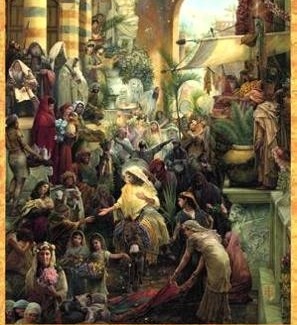
We disagree like this because we're human ---It may be our hallmark among the species :-)--- Still, there are a few things we agree on. One of them is this: one day Jesus came riding into Jerusalem on the back of a donkey. And then, for a bright shining moment, the crowd saw him as he truly was, their King.

It's difficult for us to grasp this scenario. The components seem, as one of my ancestors was fond of saying, "all whomper jawed." It stretches our credulity to think people would react with alleluias, blessings, and shouts of joy . . .

. . . to a man riding on a donkey.

So how do I explain it? My kingdom for a metaphor.

Most of us moderns have trouble relating to the extremely high level of anticipation flooding through the people of Israel at that time. I think that's why we kind of "skip over" this part when we think of what has come to be known as Passion Week. We know that the very heart of our beliefs are tied to the later events of that week. And, of course, we know that this so called "triumphal entry" was soon followed by some very UN-triumphal events, including His death. So, we "note" this procession, thinking of it as a kind of parade, and then shift our focus to what comes next.

But I am asking you to go back, to roll back the film if you will, to witness again this almost magical procession into Jerusalem. It's important, maybe more important than you've ever considered.

Imagine a man living near that city gate. He started his day having to shoulder his way through the crowds---the city is swelled with visitors readying themselves for the Passover later that week---so he could select the lamb for his family's Passover meal. Now, enjoying the relatively spacious elbow room of his rooftop, he is, perhaps, cooking that lamb. A part of his mind is certainly on the story of the first Passover and how, because of the blood of those first Passover lambs, the Angel of Death passed over the homes of his ancestors.

Another part is likely considering what everyone has been talking about: this man, Jesus, who supposedly walks on water, heals the sick, and raises the dead! Everyone had been speculating that maybe, just maybe, at long last their deliverance has come; that this is the Messiah, the Anointed One, the King who will throw off the shackle of Rome.

Then, he hears a commotion, over near the gate. He raises his eyes to take in something that, at first, he can hardly credit. He sees a man, riding into Jerusalem on a donkey; sees a growing crowd pulling off their cloaks and laying them, along with young palm fronds, into the path before the donkey.

And he feels a frisson of energy charge up his spine.

Everything is there just as predicted by the prophets: the donkey, the crowds, the shouts of "Hosanna!" and "Blessed is the King who comes in the name of The Lord!" Suddenly he finds himself running; down the steps, out the door, toward the gate; hears his own voice joining those of strangers and neighbors in joyful expression of what has been pent up for SO LONG.

He is shouting and laughing and crying, living to the fullest the greatest moment of his life. All is well! All will be well! At last, at last. Their savior has come.

People with a great desire to believe in their hope are charged with an energy that is truly mind-blowing in its intensity.

The thrill of hope.

That's what we are missing if we slide over this scene. That's what we MUST go back for. If we truly ARE believers, then this is how we must see our Lord, triumphantly arriving as our King.

###############################
http://lectionary.library.vanderbilt.edu

READINGS FOR EASTER
Acts 10:34-43
Isaiah 65:17-25
Psalm 118:1-2, 14-24
1 Corinthians 15:19-26
Acts 10:34-43
John 20:1-18
Luke 24:1-12

I know this reflection doesn't "line up" with the readings for Easter Sunday. I did this on purpose. Unless we realize just who it is we believe in, our understanding of what follows the triumphal entry is missing its best context. We must always remember with what "longing fulfilled," with what HOPE, He was welcomed into Jerusalem.

If we can even come close to that in our own joy, we will begin to understand the truth of our current relationship with God.

If you're in Waco, join us Friday at The Egg and I for some good food and something even better. We will be there at 8:00 a.m. for about an hour of thought-provoking, idea storming, thrill-inducing moments.

And absolutely full of hope.

Enjoy the week!
Steve

Sunday, February 3, 2013

Shade Number 14 Welder's Glass

(a brief Lectionary reflection by Steve Orr)

Looking directly into the sun, even for a few seconds, will destroy your retina. You would not immediately notice that damage. Your retina has no pain receptors. But the damage occurs. And it is permanent.

Sadly, many people discover this truth after trying to watch a solar eclipse through inadequate filters; sun glasses, photographic film, smoked glass, etc. In fact, the safest way to watch a solar eclipse is through reflection; not look directly at it, at all. The irony here is that it is perfectly safe to view a TOTAL ECLIPSE with the naked eye. It is the minutes before totality and those immediately after that hold the greatest threat to vision. In those minutes, many of us feel safe to look directly at the sun presuming enough of the harmful rays are blocked because the moon "covers" much of the sun.

One filter that DOES provide adequate protection for direct viewing of the eclipse before and after totality is "shade number 14 welder's glass." Have you ever looked at the glass in a Welder's helmet? At SN 14, the glass only transmits about 3 millionths of the visible light striking its surface. It is designed to protect the eyes of the wearer by keeping out all but the very brightest of lights, and it only allows a small amount of that through.

So, what do you see when you look at a Welder's helmet fitted with SN 14 glass? You see yourself. Yes, under certain circumstances you can see THROUGH it, but mostly you just see a very dark reflection of yourself and whatever is around you.

It makes me think of 1st Corinthians 13:12. I have always liked the rendering in the King James Version "For now we see through a glass, darkly; but then face to face: now I know in part; but then shall I know even as also I am known." (1 Corinthians 13:12 KJV)

Still, whether it is THROUGH a dark glass or into a dim mirror that we see, the effect is the same: an imperfect vision of reality.

The point of the 13th chapter of 1st Corinthians is this: we are to love, and we are not to allow ourselves to be distracted from that charge by ANYTHING. We all are curious to one degree or other about the great mysteries. What does the future hold? What follows death? Is there another age to come, and if so, what will it be like (and will I be there)? But we are not to know those answers just yet. And until that time, we are to be very actively engaged in faith, hope, and love.

As for me, I am happy to "see through a glass, darkly" as I sojourn here. Because, what's on the other side of that glass is very, very, very bright.


###############################
http://lectionary.library.vanderbilt.edu
READINGS FOR THE COMING WEEK
Fourth Sunday after the Epiphany (February 3, 2013)

Jeremiah 1:4-10
Psalm 71:1-6
1st Corinthians 13:1-13
Luke 4:21-30